
Building Intelligence is moving far beyond basic automation. In the past, smart buildings mainly linked HVAC, lighting, elevators, and security systems. Today, however, a new stage is emerging. AI, cloud platforms, and digital twins now enable buildings to sense conditions, predict changes, and optimize operations in real time.

As a result, the industry is shifting from “automated control” to “autonomous operation.” This shift matters because modern buildings face constant pressure. Operators must reduce energy costs, improve comfort, manage equipment risk, and support sustainability goals at the same time. Therefore, a more intelligent operating model is no longer optional. It is a strategic requirement.
From Automation to Cognitive Operations
Traditional building automation systems follow preset rules. They respond well in stable conditions. For example, they can switch lights on and off by schedule. They can also control air conditioning based on fixed thresholds. However, real buildings rarely behave in fixed patterns.
Occupancy changes by hour. Weather shifts quickly. Energy demand rises and falls. Equipment performance also drifts over time. In these dynamic conditions, rule-based control often reacts too late. It may also waste energy through overcooling, overventilation, or unnecessary runtime.
That is why Building Intelligence represents a deeper transformation. It adds a closed-loop capability: sensing, understanding, predicting, deciding, executing, and learning. In other words, the building does not only respond. It continuously improves how it responds.
Why AI Is the Core Engine
AI gives modern buildings the ability to turn raw data into operational decisions. First, it ingests data from sensors, meters, and control systems. Then, it identifies patterns across time, space, and equipment behavior. Next, it predicts likely outcomes and recommends better actions.
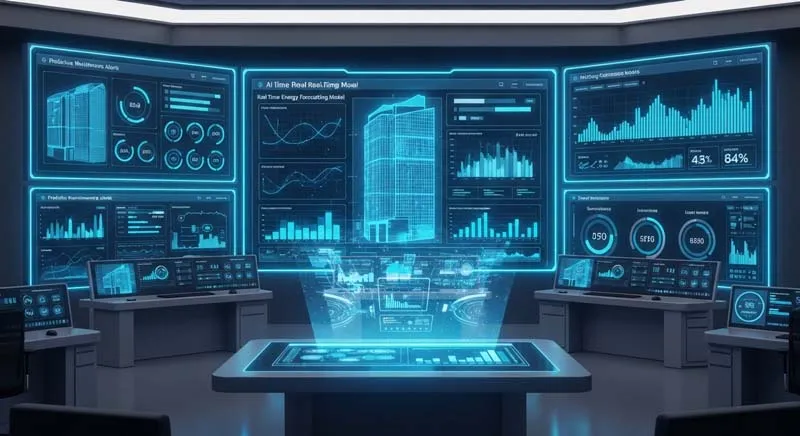
For example, AI can forecast cooling loads by combining weather data, occupancy trends, and historical consumption. As a result, operators can adjust HVAC strategies before demand peaks. This reduces energy waste and improves comfort at the same time.
In addition, AI supports predictive maintenance. It can detect abnormal vibration, temperature rise, or runtime behavior before a failure occurs. Therefore, teams can schedule maintenance earlier and avoid costly downtime. This approach improves reliability, extends equipment life, and reduces emergency repairs.
Most importantly, AI helps operations move from isolated optimization to system-level optimization. Instead of tuning a single device, it can coordinate HVAC, lighting, ventilation, and energy systems together. Consequently, the building performs better as one integrated system.
Why Digital Twins Change the Game
A digital twin gives the building an operational model in virtual space. It starts with a 3D representation of the physical asset. Then, it connects that model to live data from equipment and sensors. As a result, the model becomes dynamic rather than static.
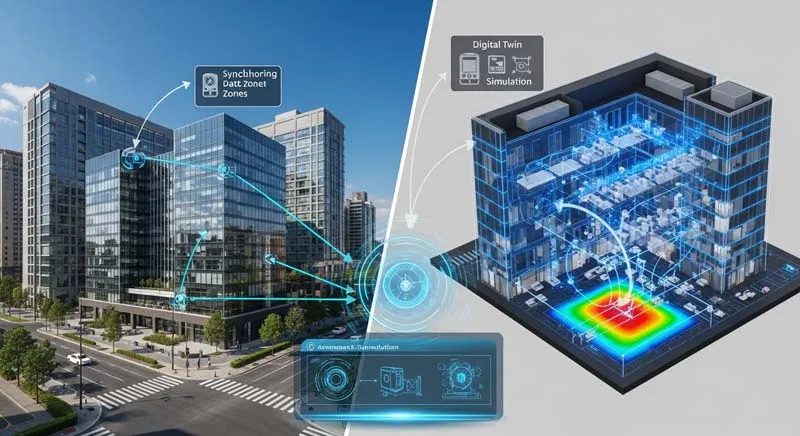
This matters because operators need more than dashboards. They need a safe place to test decisions. A digital twin provides that environment. Teams can simulate new control strategies, compare outcomes, and validate assumptions before they apply changes on-site.
For example, a manager can test different HVAC zoning strategies, lighting schedules, or peak-load control plans inside the virtual model. Then, after verifying performance, the team can push the best strategy to the physical building. Therefore, the organization lowers trial-and-error risk and improves operational precision.
In practice, Building Intelligence becomes much stronger when AI and digital twins work together. AI proposes optimized actions. The digital twin tests those actions. Then, the control system executes them. Finally, new data returns to the model for the next round of improvement. This loop creates continuous optimization instead of one-time tuning.
The Real Value for Owners and Operators
The most visible benefit is energy efficiency. Buildings consume large amounts of electricity through HVAC, lighting, and supporting systems. When operators use AI-driven forecasting and dynamic control, they can reduce unnecessary runtime and improve load scheduling. As a result, energy costs fall without sacrificing performance.
Equally important, operational management becomes more transparent. Digital twins and integrated analytics show equipment status, environmental conditions, and energy flows in one view. Therefore, teams can identify problems faster and coordinate responses more effectively.
Furthermore, Building Intelligence improves resilience. Predictive alerts reduce sudden failures. Scenario simulation helps teams prepare for peak demand, equipment outages, or abnormal usage patterns. In high-value facilities, this capability protects both service continuity and asset value.
User experience also improves. Occupants care about comfort, air quality, lighting quality, and response speed. AI-based control can adapt to changing occupancy and environmental conditions in real time. Consequently, the building feels more stable, comfortable, and responsive.
Why the Market Is Accelerating Now
Several forces now push adoption at the same time. First, energy costs and carbon targets continue to pressure owners. They need measurable efficiency gains, not just digital upgrades. Second, cloud and edge architectures now support centralized management across multiple sites. This makes scaling easier. Third, AI tools have matured, and deployment has become more practical for real operations.
Meanwhile, decision-makers increasingly expect measurable ROI. They want systems that reduce operating expenses, improve reliability, and support sustainability reporting. Therefore, Building Intelligence now aligns with both technical goals and business goals.
This is a major reason the market is growing faster. Building technology no longer serves only as an engineering upgrade. Instead, it supports operational strategy, financial performance, and long-term competitiveness.
Common Challenges and How to Address Them
Despite the promise, implementation still requires discipline. Many buildings have legacy systems with incompatible protocols. As a result, data silos often block analytics and optimization. Therefore, integration and data standardization should come first.
Data quality also matters. AI models need clean, consistent, and reliable inputs. If sensor data is noisy or incomplete, model accuracy drops. For this reason, teams should establish a clear data governance process early.
In addition, digital twins need maintenance. A model loses value when it no longer reflects the physical building. Therefore, operators should treat the twin as a living operational asset, not a one-time visualization project.
Finally, organizations must align IT, OT, and facility teams. Building Intelligence succeeds when engineering, operations, and digital teams share goals and workflows. Without that alignment, even strong technology may deliver weak results.
A Practical Path to Deployment
A successful rollout usually starts with the data foundation. Connect key systems, standardize protocols, and ensure stable data collection. Then, select high-value use cases such as energy optimization, submetering analytics, or predictive maintenance.
Next, build the digital twin around real operational needs. Focus on decision support and simulation, not visual effects alone. After that, integrate AI models into a closed control loop where validated strategies can drive real actions.
Finally, scale from one building to a campus or portfolio. At this stage, organizations can standardize methods, compare performance across assets, and improve governance. As a result, the value of Building Intelligence compounds over time.
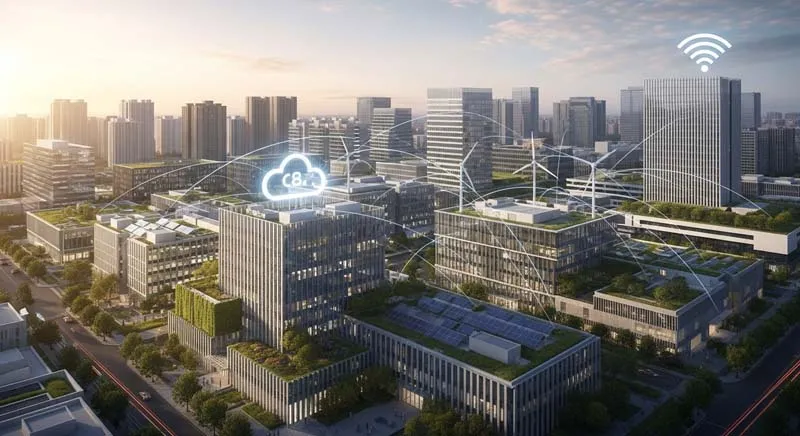
The future of smart buildings is not more automation for its own sake. Instead, it is better decisions at every level of operation. When AI acts as the brain and digital twins provide the testing ground, buildings gain the ability to adapt, optimize, and improve continuously.
In the coming years, the leaders in this space will not simply install more systems. They will build operating intelligence into the building itself. And that is the true promise of Building Intelligence.